What is power efficiency?
Power efficiency is the ratio between hashrate and the power consumption. It means how many units of hashrate can be mined with 1 watt. The power efficiency can be expressed in different formats.
- If the hashrate is expressed in H/s, the power efficiency will be expressed in H/W;
- If the hashrate is expressed in KH/s, the power efficiency will be expressed in KH/W;
- If the hashrate is expressed in MH/s, the power efficiency will be expressed in MH/W;
- If the hashrate is expressed in GH/s, the power efficiency will be expressed in GH/W;
- And so on.
You can use this measurement when comparing different results within the same algorithm. If one mining client has larger power efficiency, its ratio between hashrate and power consumption is better. This also means this mining client has higher hashrate for the same amount of power consumed.
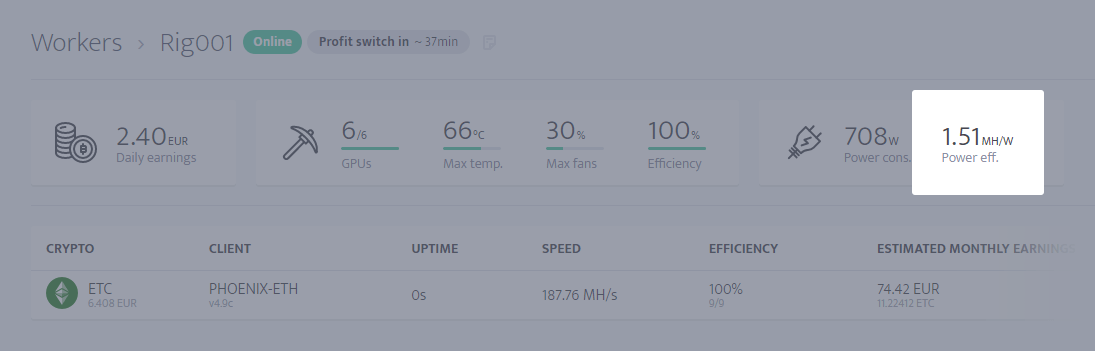
At minerstat, we are using hashrate per watt power efficiency, but in some cases you can also see the power efficiency expressed in watts per hashrate, which tells you how many watts are needed to mine with 1 unit of hashrate. In this measurement you are searching for mining clients with lower power efficiency as you want to spend less power for the same hashrate.
What is good power efficiency?
Power efficiency should always be as higher as possible since this means that you get more hashrate per watt. You can compare your own power efficiency with power efficiencies of different hardware:
- ASICs comparison is available on our ASIC miners website
- GPUs comparison is available on our GPU mining website
Power efficiency is available right under power information for each hardware. For GPUs, you might need to select algorithm first to see more relevant data as each algorithm has its own power efficiency value and power efficiencies aren’t comparable between different algorithms. For example, you can compare GPUs on Etchash by selecting Etchash algorithm and clicking [Calculate].
How to improve power efficiency?
You can improve your power efficiency by increasing the hashrate and lowering the power consumption. To do that, you can use different tools:
- ClockTune for overclocking and undervolting — you can find reference values for start on our hardware pages;
- AMD Memory Tweak for on the go memory timings changes on AMD cards;
- BIOS flasher for flashing better BIOS to AMD cards or console BIOS flash for Nvidia cards;
- Benchmarking: Try out different mining clients to see which one brings higher hashrate and lowest consumption for your hardware.
Revolutionize your mining operation with minerstat
It’s easy and free to get started. Monitor, manage, and optimize your mining rigs with our powerful platform.
What is mining efficiency?
Mining efficiency is the ratio between accepted and rejected shares. You can calculate it by formula accepted/(accepted+rejected) . It is important to strive towards 100% efficiency, as any lower number means lower stability and profitability.
Why do shares get rejected?
There are two main reasons why shares get rejected:
- Stale share: The share will be stale when you have internet issues or when pool or mining client doesn’t process the share fast enough. In most cases, this can be solved by decreasing the latency between your rig and the pool you are mining to — either by selecting a pool’s stratum address that is closer to you or by switching to some other pool.
- Invalid/rejected: The share will be rejected when you have issues with your hardware, you are using too agressive overclocking settings, or if mining client have compatible issues. This can be solved by inspecting your hardware, improving your overclocking settings, or changing mining client.
What is bad efficiency?
If your efficiency is lower than 98%, we suggest you check your overclocking settings and/or the pool you use for mining. To find the pool with lowest latency and possibility for better efficiency, we suggest to use our software Sonar. Do note that even the pools with lowest possible latency can have low efficiency for your setup, so it is important to select a pool which will allow you mining with full efficiency.
Historical chart of efficiency is available for each worker in worker statistics.
0% efficiency
The reasons for 0% efficiency are different:
- Waiting for first share: If you have just started to mine and you only have 1 GPU, it can take up to few minutes to find a first share. Until you find a first share and it gets accepted by the pool, you will see 0% efficiency — 0 accepted shares and 0 rejected shares.
- Error in the config: If you have just started to mine and you don’t see hashrate while your efficiency is 0%, it means you have an error in the config. Check our the snapshot console or what mining client is saying. It will usually display you information, such as wrong username, pool rejection, etc. You will need to troubleshoot your config in order to fix it, try different mining client, or try different pool.
- Pool rejecting your shares: If you are mining for few minutes and you see hashrate, but your efficiency is 0%, it means pool is rejecting all of your shares. The reason could be incorrect authorization, overclocking, poor latency, or something else. You can find the possible reasons in the mining client’s output.
Where can I check my efficiency?
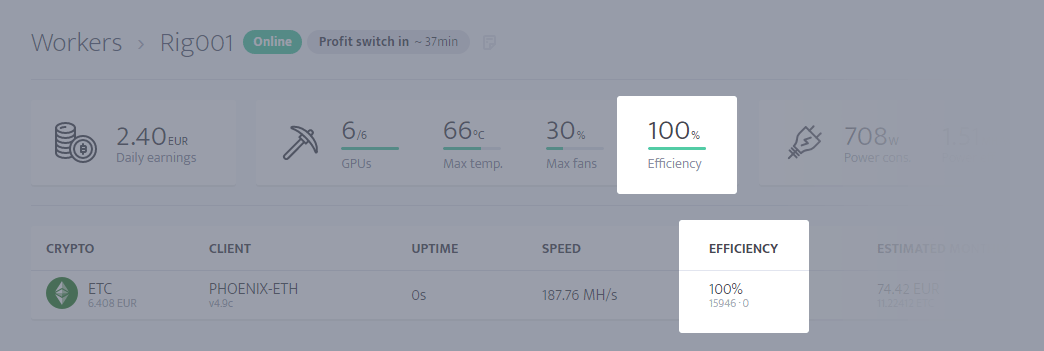
You can find efficiency and the number of accepted and rejected shares on the workers’ list and on your worker’s profile summary and mining table.
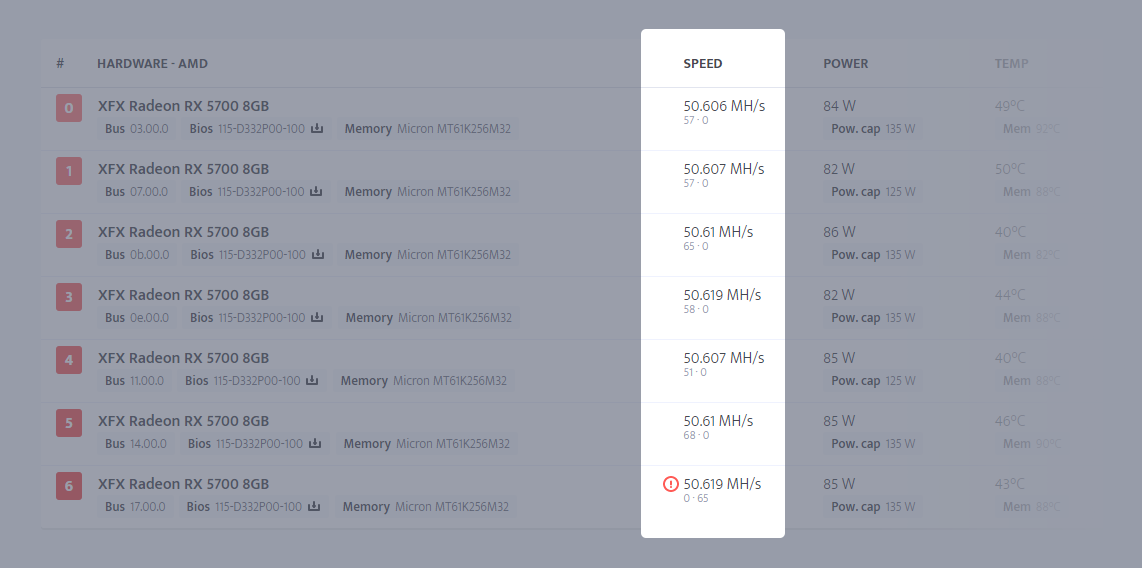
For some mining clients we also show number of accepted and rejected shares under the hashrate in the hardware table.
How to fix low efficiency?
First, check on the pool if you are getting rejected or stale shares.
- Rejected shares: You will need to adjust your overclocking settings or check if hardware is properly connected, risers working, and test different mining client.
- Stale shares: You will need to select some other pool address that is closer to you (for EU choose EU pool address, for USA choose USA pool address, etc.) or switch to other pool. If you can’t get it to improve, you can take a look at our Stratu.ms service.
How to reset shares?
The accepted and rejected shares are reported as mining client reports it. Mining clients usually don’t reset them, so if you are running mining client for 30 days, you see accepted and rejected shares in the last 30 days. As soon as you restart mining client (or reboot the rig), the counting starts from 0. Then it again counts the accepted and rejected shares and sum them up. Pool, on the other hand, usually shows accepted and rejected shares in last X period — for example, for last hour, or for last 6 hours.
How to escape low efficiency?
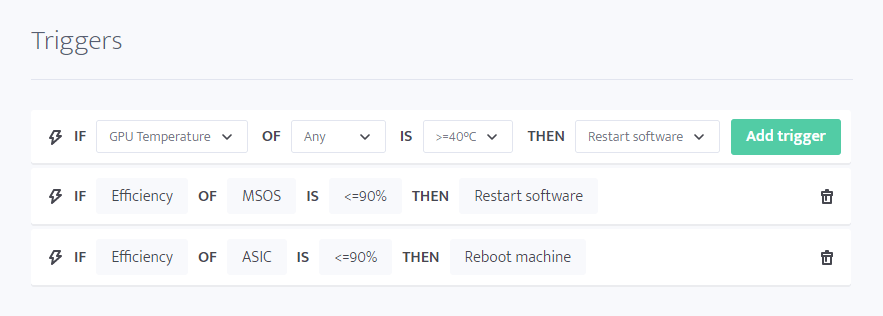
In some cases efficiency might become problematic after a while of mining (for example, for older ASICs). For such cases, you can set up a trigger that will restart your mining client (GPU rigs) or reboot your machine (ASICs) when the efficiency drops below 90%.
Revolutionize your mining operation with minerstat
It’s easy and free to get started. Monitor, manage, and optimize your mining rigs with our powerful platform.
Efficiency mining

Let’s define efficiency as doing more with less. In other words, helping miners deliver the same amount of output with less input. In a mine site, increased efficiency could mean haul trucks deliver more with less fuel and energy. It could also mean mine operators able to oversee more equipment at once.
- How do you calculate mining efficiency?
- What is Bitcoin mining efficiency?
- What is sustainable mining?
- How much Hashrate is needed to mine 1 ETH?
- How long does it take to mine 1 Bitcoin?
- How does in situ mining work?
- Can mining be green?
- How much does a Dogecoin cost?
- Is mining Bitcoin illegal?
- Can I mine Bitcoin on my phone?
- What makes the mining unsustainable?
How do you calculate mining efficiency?
The lower the number, the more profit it nets. For example, a Whatsminer M20S 68 TH/s, which entered the market in 2019, runs at 3360 W. So, efficiency = 3360 W / 68 TH = 49.
What is Bitcoin mining efficiency?
Electricity is not only required for running computations on mining systems but also to cool them and prevent them from overheating. Efficiency: This value is a function of the difficulty level and efficiency in the number of calculations that your mining system to win the puzzle.
What is sustainable mining?
Sustainable mining is the minimization of negative environmental, social, and economic impacts associated with mining and processing activities while limiting extraction to rates that do not exceed capabilities to establish new sources, substitutes, or recycle any particular material so as to not compromise potential .
How much Hashrate is needed to mine 1 ETH?
To mine 1 Ethereum, you require a rig with a hash rate of 15,500 megahash a second or mh/s. This is the speed of your mining rig. To build a mining rig with such a high hash rate, you require more than 50 GPUs, which would cost you more than $100,000.
How long does it take to mine 1 Bitcoin?
How Long Does It Take to Mine One Bitcoin? In general, it takes about 10 minutes to mine one bitcoin. However, this assumes an ideal hardware and software setup which few users can afford. A more reasonable estimate for most users who have large setups is 30 days to mine a single bitcoin.
How does in situ mining work?
In-situ leach mining involves pumping of a lixiviant into the ore body via a borehole, which circulates through the porous rock dissolving the ore and is extracted via a second borehole. . For copper, acids are generally needed to enhance solubility of the ore minerals within the solution.
Can mining be green?
Green technology requires non-renewable raw materials sourced from primary geological resources (mines) or secondary supply (reuse or recycling). The ambition is a fully circular economy, in which demand can be satisfied by reuse and recycling; however, we are not yet at that point.
How much does a Dogecoin cost?
The current price is $0.1575 per DOGE.
Is mining Bitcoin illegal?
The legality of Bitcoin mining depends entirely on your geographic location. The concept of Bitcoin can threaten the dominance of fiat currencies and government control over the financial markets. For this reason, Bitcoin is completely illegal in certain places.
Can I mine Bitcoin on my phone?
You can mine Bitcoin or any other cryptocurrency on your smartphone. . This technology is the same as mobile crypto mining, just on a smaller scale. Users can join a mining pool with a smartphone. Your smartphone then adds up its computing power to the system.
What makes the mining unsustainable?
“Mining is inherently unsustainable: It is destructive to the biophysical environment, and its contributions to human well-being are uneven and often overwhelmed by the social and economic damage it inevitably inflicts. Mining must be drastically scaled back, not expanded.

Bitcoin
What is the difference between nodes and miners?Are miners full nodes?What is a mining node?What is a Bitcoin mining node?Do you get paid to run a Bi.

Satoshi
What did Satoshi Nakamoto create?How many Bitcoins does Satoshi own?How rich is Satoshi now?What happens if Satoshi sells?Is Elon Musk Satoshi Nakamo.

Wallet
How does a HD wallet work?What is a hardened key?How do deterministic wallets work?What is XPRV?What is an HD Key?What is a deterministic key?What is.
Website about cryptocurrencies. A lot of useful and interesting information about trading, platforms, courses and the most profitable investments in cryptocurrencies
Efficiency в майнинге что это
Mining efficiency is the ratio between accepted and rejected shares. You can calculate it by formula accepted/(accepted+rejected) . It is important to strive towards 100% efficiency, as any lower number means lower stability and profitability.
Why do shares get rejected?
There are two main reasons why shares get rejected:
- Stale share: The share will be stale when you have internet issues or when pool or mining client doesn’t process the share fast enough. In most cases, this can be solved by decreasing the latency between your rig and the pool you are mining to — either by selecting a pool’s stratum address that is closer to you or by switching to some other pool.
- Invalid/rejected: The share will be rejected when you have issues with your hardware, you are using too agressive overclocking settings, or if mining client have compatible issues. This can be solved by inspecting your hardware, improving your overclocking settings, or changing mining client.
What is bad efficiency?
If your efficiency is lower than 98%, we suggest you check your overclocking settings and/or the pool you use for mining. To find the pool with lowest latency and possibility for better efficiency, we suggest to use our software Sonar. Do note that even the pools with lowest possible latency can have low efficiency for your setup, so it is important to select a pool which will allow you mining with full efficiency.
Historical chart of efficiency is available for each worker in worker statistics.
0% efficiency
The reasons for 0% efficiency are different:
- Waiting for first share: If you have just started to mine and you only have 1 GPU, it can take up to few minutes to find a first share. Until you find a first share and it gets accepted by the pool, you will see 0% efficiency — 0 accepted shares and 0 rejected shares.
- Error in the config: If you have just started to mine and you don’t see hashrate while your efficiency is 0%, it means you have an error in the config. Check our the snapshot console or what mining client is saying. It will usually display you information, such as wrong username, pool rejection, etc. You will need to troubleshoot your config in order to fix it, try different mining client, or try different pool.
- Pool rejecting your shares: If you are mining for few minutes and you see hashrate, but your efficiency is 0%, it means pool is rejecting all of your shares. The reason could be incorrect authorization, overclocking, poor latency, or something else. You can find the possible reasons in the mining client’s output.
Where can I check my efficiency?
You can find efficiency and the number of accepted and rejected shares on the workers’ list and on your worker’s profile summary and mining table.
For some mining clients we also show number of accepted and rejected shares under the hashrate in the hardware table.
How to fix low efficiency?
First, check on the pool if you are getting rejected or stale shares.
- Rejected shares: You will need to adjust your overclocking settings or check if hardware is properly connected, risers working, and test different mining client.
- Stale shares: You will need to select some other pool address that is closer to you (for EU choose EU pool address, for USA choose USA pool address, etc.) or switch to other pool. If you can’t get it to improve, you can take a look at our Stratu.ms service.
How to reset shares?
The accepted and rejected shares are reported as mining client reports it. Mining clients usually don’t reset them, so if you are running mining client for 30 days, you see accepted and rejected shares in the last 30 days. As soon as you restart mining client (or reboot the rig), the counting starts from 0. Then it again counts the accepted and rejected shares and sum them up. Pool, on the other hand, usually shows accepted and rejected shares in last X period — for example, for last hour, or for last 6 hours.
How to escape low efficiency?
In some cases efficiency might become problematic after a while of mining (for example, for older ASICs). For such cases, you can set up a trigger that will restart your mining client (GPU rigs) or reboot your machine (ASICs) when the efficiency drops below 90%.
It’s easy and free to get started. Monitor, manage, and optimize your mining rigs with our powerful platform.
Mining efficiency and latency effects
Decentralized networks are based on multiple computing nodes, rather than depending on a single server to handle all the workloads. In contrast to a centralized network, a decentralized system offers several advantages, such as increased reliability, scale, and privacy. This means that the network is decentralized so there is not a single point of failure, which is the result of the fact that users don’t have to rely on a centralized server for all processes. Additionally, decentralized networks are much easier to scale, because the network can be expanded by simply adding more machines. As well, this architecture provides greater privacy, since information is not routed through one point but rather through a multitude of points. Peer-to-peer (P2P) networks are a decentralized network based on peers sharing information and resources. A group of nodes act as a peer for each other, storing and sharing files collectively. Using a common protocol, they are working together to create a network capable of transferring any kind of data. This allows the members to exchange information without having to go through an intermediary. In order to accomplish this, P2P networks rely on protocols called application protocols (Layer 7 in OSI model) on top of the Internet protocol suite (TCP/IP). P2P networks operate in a relatively straightforward manner. Basically, what is done is to build a protocol so that nodes can communicate with each other directly and without intermediate. Figure 1 presents an example of P2P networks. In this model, each device can function independently, and decisions will be taken by consensus.
On the other hand, on a cryptocurrency’s network, devices should be able to send transactions and suggest new blocks. Therefore, we would need a P2P network that allows nodes to communicate with one another.
I. P2P in Blockchain
P2P networks maintain blockchains as decentralized data ledgers. The blockchain is a protocol for recording transactions between the network peers, who adopt the consensus protocol in order to ensure those transactions are recorded. The consensus system for Bitcoin, is known as Proof-of-Work (PoW). Miners are nodes that compete to solve a difficult cryptographic challenge using a brute force search technique. The first miner to find a solution that contains all of the pending transactions in a block is rewarded with newly created crypto-coins. Miners are compensated by these rewards as a result of the operational cost mainly resulting from the consumption of electricity. A miner is awarded proportionally to how much it contributes in terms of computational effort in the protocol. Whenever the P2P network grows, the mining power owned by one miner shrinks, reducing the chances of repeating the gains. Because of that, miners are exposed to increasing operating costs, which has caused them to join forces and form mining pools [1]. A mining pool’s internal networks are typically client-server. For a mining pool to manage its miners, it uses dedicated servers. In order to mine, miners must be connected to pool servers that assign them jobs and notify them of new blocks. An discovered block is transmitted to the entire network once it has been discovered by a miner. Miner block reception latency is the time elapsed between the discovery of a block and its reception by the miner. Figure 2 shows a PoW-based blockchain operation.
II. Mining of blocks
The blockchain consists of blocks, which are composed of a header and the list of transactions. In addition to the time and date of creating the block, it usually includes the block height (inside the blockchain), the hash of the block, and the hash of the previous block. In order to obtain a block’s hash, a large character string is created by concatenating the headers and transactions, and a hash function is applied to the message. Data of arbitrary size can be mapped to fixed-size values with a hash function. Applications using blockchain hash functions must be cryptographic, one-way and deterministic. A message with any given hash value must be nearly impossible to generate or to locate two messages with the same hash value. If only a tiny change is made in the message, the hash value can change dramatically. The new hash seems unrelated to the previous one [3]. This can be seen in applications such as bitcoin, where messages are turned into hashes of 256 bits using the SHA-256 function (See https://emn178.github.io/online-tools/sha256.html). For instance the hash of the title of this blog is
By mining a block, one finds a hash value for a block that is lower than some target, a task that can only be performed by brute force due to the properties of cryptographic hash functions. Prior to applying the hash function to the block message, a nonce is appended to the block message in order to search for an appropriate hash value. Miner’s draw random 32-bit numbers until a value is found for a nonce that effectively results in a correct block hash.
III. Orphan and Stale blocks
When two miners are solving the PoW puzzle at the same time on a blockchain, there can be unintentional forks when these miners try to tell the rest of the network they’ve won a block. This process of communication (propagation) does not happen instantly, due to latency. As an example, let’s consider we have a fork when miner A and miner B find a valid (n+1)th block of the network as follow:
Under this scenario, each miner will broadcast his “winning” block to their nearest neighbors, who will then repeat the process. When the entire chain is aware of both # (n+1) and # (n+1)’, nodes will link the block # n as a reference/parent and keep the block they saw first at the head (# (n+1) or # (n+1)’). Let’s assume that a miner with # (n+1) as its heading block mines the next block # (n+2). This generates a longer chain for Miner B and as a result the entire network will follow the longest chain and cutt off the fork for # (n+1)’ which will be without a parent and be called an orphan block. Moreover, the orphan’s offspring block also is not included in the blockchain and marked as a stale block. The important note is that miners will not receive reward for stale blocks and it reduces the efficiency of mining.
IV. Mining efficiency
The mining efficiency is calculated by dividing the number of accepted shares and rejected shares, i.e.,
Mining Efficiency =accepted/(accepted+rejected) .
Generally, shares get rejected for two reasons:
A. When you are experiencing internet issues or when a pool or mining client is not processing the share as quickly as it should, then the share will be stale. This is usually fixed by decreasing the latency between the pool and your rig.
B. Shares can be rejected if their clients have compatibility issues or if there are issues with their hardware or overclocking settings.
V. Latency effect in the mining process
The term network latency, also known as lag, is used to describe communication delays over the network. A packet of data taking time to capture, transmit, process through multiple devices, then receive at its destination and decoded would be considered latency in networking. Low-latency networks have short transmission delays (desirable), while high-latency networks have longer transmission delays (undesirable).
In the mining process, TCP/IP connections to the pool expose us to the software that controls the pool, which may behave differently than the lower-level components of the operating system that handle Internet Control Message Protocol responses. What we are discussing in this article is propagation delay which is different from latencies caused by queuing delay in transaction submission or block generation delay. A large part of the latency can be attributed to the distance between the mining rig and the mining pool from which you request work [3–4].
There are some tools to check the latency between the mining pool and your rig such as:
- stratum-ping v1.0.0 : https://github.com/2miners/stratum-ping/releases/tag/v1.0.0
- Sonar: https://minerstat.com/software/sonar
- Stratum: https://stratu.ms/latency-check
Having a large latency can increase the number of orphan/stale blocks for a miner and leads to low efficiency. To illustrate the subject, let’s have a stratum ping latency comparison between different pools. Using some ping tools one can often evaluate the performance of various mining pools. Thus, it is preferable to measure the response time from the pool due to the possibility that they could be busy or using geolocation-based forwarding, positioning the connecting endpoint closer to the user. For a particular pool, servers are generally located all over the globe. Instead of using the general URL, one should use the location-specific URL for a better connection and lower latency. As an example, let’s consider Slush Pool. From our location in Marseille, France, we realized latency results from different stratum servers of Sluch Pool as follows. Please note that the pool latency determines how quickly you can send and receive hashes. It is worth mentioning that if your ping is less than 100ms, you have a good ping.
The result shows that considering our location, the Europe server of Slush Pool has the lowest latency compared to its other servers located all around the world. It is possible to obtain the same table for other pools such as binance pool, Hiveon pool, etc. .
VI. Conclusion
Mining is the process of solving many hashes as fast as possible. Adding any latency will have a negative effect on this fast process. This means that, in the mining process, high latency leads to a share not reaching the job deadline, being rejected, and as a result, not being paid for. Crypto miners need to pay attention to latency because it can impact their revenue. Some solutions can be considered to improve the latency such as moving the mining farm as close as possible to the pool’s location, or choosing the pool nearest the mining farm. Also, more bandwidth can be useful to reduce latency as more data packets can travel over a wider pipeline, thereby reducing the possibility of packets getting delayed.
1- H Albrecher, D Finger, PO Goffard, “Blockchain mining in pools: Analyzing the trade-off between profitability and ruin”; Insurance: In 2022 Mathematics and Economics, Elsevier,1–34.
2- Wilhelmi, Francesc and Barrachina-Muoz, Sergio and Dini, Paolo, “End-to-End Latency Analysis and Optimal Block Size of Proof-of-Work Blockchain Applications”; arXiv preprint arXiv:2202.01497, 2022, 1–4.
3- Christian Decker and Roger Wattenhofer, “Information propagation in the bitcoin network”; In IEEE P2P 2013 Proceedings, IEEE, 1–10.
4- Ryunosuke Nagayama, Ryohei Banno, and Kazuyuki Shudo, “Identifying impacts of protocol and internet development on the bitcoin network”; In 2020 IEEE Symposium on Computers and Communications (ISCC), IEEE, 1–6.
5- Tong Cao, Jérémie Decouchant, Jiangshan Yu, and Paulo Esteves-Verissimo, “Characterizing the Impact of Network Delay on Bitcoin Mining”; In 2021 40th International Symposium on Reliable Distributed Systems (SRDS), IEEE, 109–119.
Энергоэффективность ASIC майнеров и что это такое
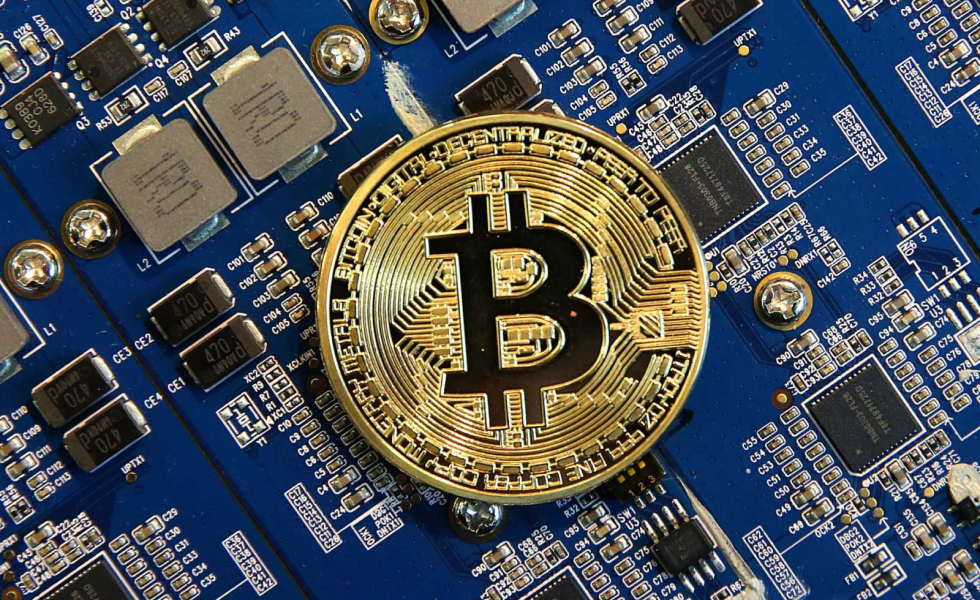
Энергоэффективность asic-майнера, или майнера на интегральной схеме, специфичной для конкретного приложения,— это показатель того, сколько энергии требуется для добычи одной единицы криптовалюты. Этот показатель можно использовать для сравнения различных типов оборудования для майнинга, и он может дать представление об их производительности и рентабельности.
Обзор факторов, которые могут влиять на энергоэффективность
Энергоэффективность конкретного asic-майнера определяется его конструкцией, а также типом и скоростью, с которой он хэширует данные. Другие факторы, такие как системы охлаждения и эффективность электропитания, также играют роль в определении энергоэффективности.
Факторы, влияющие на энергоэффективность asic-майнеров
Сложность майнинга — это количество вычислительной мощности, необходимое для генерации одной единицы криптовалюты с помощью заданного алгоритма или протокола. Чем сложнее процесс майнинга, тем больше требуется вычислительной мощности, что приводит к более высокому потреблению энергии на каждую сгенерированную единицу и снижению общей энергоэффективности устройства или системы, используемой в майнинге.
Скорость хэширования и энергопотребление
Скорость хэширования характеризует, насколько быстро майнер asic может обрабатывать данные с помощью встроенных алгоритмов или протоколов; этот параметр часто определяет, сколько времени требуется майнерам для генерации одной монеты или токена на основе технологии блокчейн (например, биткоина). Чем выше скорость хэширования у asic-майнера, тем выше потребление электроэнергии на каждую сгенерированную единицу, что приводит к снижению общей энергоэффективности устройства или системы, используемой в майнинге.
Роль энергоэффективности при выборе оборудования
Преимущества и недостатки покупки оборудования с более высокой энергоэффективностью
При выборе оборудования для криптодобычи важно взвесить обе стороны: преимущества и недостатки, связанные с покупкой устройств с более высоким уровнем энергоэффективности по сравнению с теми, которые менее эффективны, но могут иметь другие преимущества, такие как экономия затрат при рассмотрении долгосрочных целей прибыльности. С одной стороны, покупка устройств с более высоким уровнем энергоэффективности означает, что со временем они будут потреблять меньше электроэнергии, что приводит к денежной экономии на эксплуатационных расходах за счет более низких счетов от коммунальных компаний; однако такие машины могут быть изначально дороже, чем их аналоги с более низким уровнем эффективности. Поэтому при принятии решения о выборе типа (типов) оборудования необходимо тщательно взвесить, исходя из индивидуальных потребностей и предпочтений, а также бюджетных ограничений.
Заключение
Заключение краткое изложение того, что обсуждалось, и важность выбора оборудования на основе его энергоэффективности в этой статье мы обсудили, какое влияние оказывает уровень энергопотребления (или хэшрейт) майнера asic на его общий уровень энергоэффективности и как этот параметр можно использовать при выборе оборудования для операций по добыче криптовалют. Мы выделили преимущества и недостатки, связанные с приобретением устройств с высоким и низким уровнем энергоэффективности, а также важность тщательного рассмотрения бота перед принятием решения о том, какой тип (типы) приобрести, исходя из индивидуальных потребностей и предпочтений, а также бюджетных ограничений.
Что такое хешрейт: как считать H/s
Скорость хеширования – это такой показатель, который является одним из самых важных в процессе майнинга криптовалюты, так как она напрямую влияет на итоговую прибыль майнера. Поэтому ее нужно обязательно учитывать при выборе как блокчейна, так и оборудования.

Что такое хэшрейт
Слово «hashrate» используется для обозначения единиц измерения мощности устройств, которые применяются для добычи криптовалюты. Чем выше хэшрейт, тем мощнее оборудование. Сейчас есть большой выбор техники, созданной специально для расшифровки хэша. Одним из самых известных примеров являются Asic-майнеры.
В случае с майнингом под мощностью нужно понимать скорость решения криптографической задачи. Чтобы решить одну задачу, нужно выполнить тысячи отдельных мелких операций. Цифра хешрейта показывает, сколько таких вычислительных действий в секунду может произвести оборудование для майнинга.
Подключение вычислительных мощностей разных пользователей необходимо для поддержания стабильной работы блокчейна, и при использовании техники с высоким хэшрейтом шансы на успешную добычу блока ощутимо возрастают. За каждый такой блок майнер получает вознаграждение в виде криптовалюты того блокчейна, с которым он работает.
Уже запущено немало блокчейнов с механизмом добычи блоков на основе алгоритма POW – доказательства выполненной работы. При этом уровень сложности криптографических задач у разных цепочек блоков может сильно отличаться.
для добычи блока в сети биткоина требуется вычислительная мощность на уровне 203 EH/s;
хешрейт Doge составляет 347.883 TH/s;
у криптовалюты ZEC этот показатель находится на уровне 6.94 GH/s.
То есть для майнинга биткоина нужно самое мощное оборудование. В случае с ZEC подойдет техника попроще.
Зная точную вычислительную мощность асика/видеокарты, можно посчитать, сколько получится добыть отдельной криптовалюты за день, неделю или месяц. Без точных цифр по хешрейту техники и блокчейна спрогнозировать прибыль не получится.
Одним из популярных решений для увеличения скорости майнинга являются пулы. Так называют группы майнеров, которые объединяют свои вычислительные мощности для более быстрого решения криптографических задач разных блокчейнов.
Как измеряется скорость хеширования
Для определения вычислительной скорости используется такой показатель, как H/s. Это количество хеша (операций) в секунду. Разница между H/s у отдельных криптовалют может быть значительной. Поэтому специалисты используют уточняющие обозначения, например, Mega hash или Giga hash.
Ниже представлена таблица с полным списком.
Количество хэшей в секунду
Чтобы правильно вычислить потенциальную прибыль от майнинга, нужно обращать внимание не только на цифру хешрейта блокчейна, но и на его буквенное обозначение:
Хэшрейт монеты ZEC составляет 6.94 GH/s. Для успешного майнинга этой монеты потребуется оборудование, способное выполнять 6,94 миллиардов операций в секунду при попытке добыть блок.
В случае с ВТС цифры совсем другие – 203,5 EH/s. Это значит, что успешный майнинг биткоина возможен при вычислительной мощности на уровне 203,5 квинтиллиона операций в секунду. Такую производительность трудно обеспечить даже при помощи фермы асиков. По этой причине для добычи ВТС майнеры и объединяются в пулы.
Майнить криптовалюту с высоким хешрейтом при помощи стандартной техники бессмысленно. Видеокарта или асик просто не сможет выполнять необходимое количество операций в секунду для успешной добычи блока.
Чтобы получить хороший результат, необходимо купить мощное оборудование. Также важно выбирать монеты с таким уровнем хешрейта, который сможет потянуть имеющийся процессор, асик или видеокарта, так как эффективность майнинга от одного и того же оборудования может изменяться при выборе разной криптовалюты.
Если взять в качестве примера GPU 1 RX570, 8 Гб, то можно получить следующие результаты:
CryptoNightR – 730 H/s;
То есть при работе с разными децентрализованными сетями производительность видеокарты будет заметно отличаться.
Также нужно учитывать алгоритм хеширования выбранной монеты. Например, в блокчейне ВТС используется метод шифрования SHA256. Соответственно, если стоит цель купить ASIC для добычи биткоина, нужно выбирать такую модель, которая поддерживает алгоритм хеширования SHA25.
Какой уровень хэшрейта считается хорошим
Майнеры заинтересованы в том, чтобы блокчейн, с которым они работают, был максимально надежен. В этом случае чем выше хешрейт, тем лучше.
Если для добычи блока нужно подключать значительные вычислительные мощности, то взлом системы становится очень сложной задачей. Для этого потребуется получить контроль над 51% мощности сети. То есть чтобы преодолеть защиту биткоина, придется потратить огромную сумму денег. При этом сам майнинг надежной криптовалюты будет дорогим из-за расходов на оборудование и электроэнергию.
Если речь идет о долгосрочных планах по добыче цифровых монет, то выбирать нужно такие сети, у которых хешрейт высокий и постоянно растет. Например, за 2020—2021 годы хешрейт биткоина вырос на 49%.
Выгодный уровень вычислительной мощности
Для майнеров с небольшим стартовым капиталом лучшим вариантом будут сети с умеренной сложностью. В этом случае их шансы на добычу блока выше, чем при работе с «тяжелыми» блокчейнами.
Уровень надежности сетей с умеренным хешрейтом ниже, но зато майнер сможет получить прибыль. А когда появятся более серьезные средства, можно перейти к блокчейнам с высокой конкуренцией за добычу блока.
Внимание нужно обращать и на размер вознаграждения за добытый блок. У разных сетей он может сильно различаться. Плюс многие проекты (по примеру биткоина) периодически производят «уполовинивание» (халвинг) вознаграждения. С каждым халвингом эффективность хешрейта оборудования снижается вдвое.
В итоге самым выгодным вариантом для майнеров-одиночек являются сети с умеренным уровнем хешрейта, хорошим вознаграждением и монетой, имеющей потенциал роста. Майнить актив без явных перспектив повышения его котировок тоже бессмысленно.
Важно не забывать о расходах на электроэнергию. Некоторые асики могут потреблять заметные объемы. Итоговая сумма заработка может ощутимо уменьшится, если одновременно работает несколько единиц техники с высоким хешрейтом. По этой причине есть смысл потратить время на подбор техники с низким энергопотреблением.
Определять прибыльность майнинга удобно при помощи специальных калькуляторов. В них можно внести цену за электричество, модель видеокарты/асика и количество единиц техники. В итоге сервис выдает точные цифры потенциальной прибыли.
Существуют также специальные сайты для определения доходности видеокарт по моделям.
Подобные сервисы можно найти и для оценки потенциальной прибыли асиков.
Если майнинг будет производиться через пул, то нужно учитывать размер комиссии и количество доступных для добычи криптовалют. Например, Binance Smart Pool позволяет добывать Bitcoin, Bitcoin Cash и Bitcoin SV.
Как узнать уровень хешрейта
Сведения по вычислительной мощности асика можно найти на странице производителя или магазина, который его продает. В большинстве случаев уровень хешрейта указывается в названии товара.
В качестве примера можно привести ASIC Innosilicon A10 Pro. На странице продавца указывается, что уровень хешрейта этого оборудования составляет 500 МН/s. А в описании можно прочитать более подробную информацию:
уровень шума – 75 Дб.
потребление – 850 Вт.
Здесь сразу видно, какой алгоритм хеширования используется, сколько энергии будет потреблять техника и насколько шумным является асик.
Зная характеристики оборудования, можно получить данные по разным типам хешрейта. Для этой цели используются калькуляторы преобразования мощности. Если производитель указал, что конкретный асик способен выдавать 600 МН/s, то нужно выбрать в калькуляторе поле мегахэша и ввести там цифру 600. После этого в других полях появятся рассчитанные калькулятором цифры.
Такой калькулятор позволяет быстро сравнить мощность оборудования для майнинга с текущим хешем блокчейна выбранной монеты. Достаточно ввести показатель сети и сравнить полученные цифры с характеристиками асика или видеокарты.
Например, 2 января 2022 года хешрейт сети биткоина достиг отметки в 203,5 EH/s. Если ввести в калькулятор эти данные, то можно получить цифры по другим категориям хешрейта.
Такие вычисления позволяют понять, что для успешного майнинга ВТС необходимо оборудование с мощностью в 203 500 000 000 000 MH/s. Очевидно, что одного асика с хешрейтом 600 MH/s будет недостаточно для добычи биткоинов.
Такой же калькулятор можно использовать и для определения вычислительной мощности пула майнеров. Точные цифры помогут выбрать лучший вариант для добычи отдельной монеты.
Что влияет на уровень хешрейта
Важно понимать, что вычислительная мощность, указанная в характеристиках техники, является только потенциальной ее эффективностью. Реальная скорость добычи зависит от многих дополнительных факторов и поэтому может отличаться от стандартизированных данных из таблиц и калькуляторов.
Часто мощность снижается по таким причинам:
Способ подключения. Понижение хешрейта может быть связано с типом разъема на материнской плате, который используется для подключения видеокарты. У разных интерфейсов отличается скорость передачи данных.
Температура чипов. Любое оборудование, обладающее мощными вычислительными элементами, нагревается. ASIC не исключение. Чем выше температура схемы асика, тем меньше операций в секунду он производит. По этой причине важно обращать внимание на качество системы охлаждения. Использование дешевых и слабых вентиляторов может привести к снижению уровня хешрейта или даже к поломке оборудования. Желательно не допускать нагрева чипов выше 80 °C.
Операционная система. ОС обеспечивает работу скрипта, запускающего подбор хеш-функций, и выполняет ряд служебных задач. На последние может расходоваться заметная часть ресурсов видеокарты или процессора. Чем «прожорливее» система, тем ниже итоговый хешрейт. Лучшими вариантами для майнинга считаются такие ОС, как Ubuntu и Debian.
Тайминги. Имеется в виду время, необходимое видеокарте или процессору для выполнения одной команды. Те настройки, которые установлены по умолчанию, могут блокировать максимальный уровень эффективности купленного оборудования. На специализированных порталах можно найти тайминги под добычу конкретной монеты. При их установке будет нейтрализован простой карты в ожидании новой команды после выполнения предыдущей. Тайминги записываются на флешку в виде файла и прошиваются в системе через BIOS. Если правильно установить такой файл, то можно повысить хешрейт видеокарты на 20%.
Pool для майнинга. Пулы могут использовать разные схемы взаимодействия участников и подключать собственные скрипты для эффективной добычи криптовалюты. По этой причине нужно внимательно мониторить доступные варианты. Не все скрипты составлены грамотно. Важно учитывать и размер комиссии. Нередко она имеет форму части хешрейта участников, идущей непосредственно владельцу пула.
Как можно заметить, для максимально эффективного майнинга нужно учитывать сумму факторов, влияющих на итоговый хэшрейт оборудования.
Как происходит распределение хэшрейта
Блокчейн с механизмом консенсуса PoW устроен таким образом, что вычислительные мощности для поддержки системы собираются со всего мира. И свой вклад в обеспечение безопасности сети вносят сотни тысяч майнеров.
Теоретически вычислительные ресурсы полностью децентрализованы и распределены по всей планете, но в реальности это не совсем так. Если посмотреть на данные блокчейна ВТС, то можно заметить, что основная часть майнеров биткоина находится в Китае, США и Казахстане.
Китайская доля составляет минимум 46% (в начале 2022 года). Это значит, что вероятность добычи нового блока на территории Китая ощутимо выше, чем в других странах. А при внезапном отключении электричества в крупных городах КНР надежность блокчейна биткоина резко упадет.
Единственный способ успешно добывать ВТС на фоне такой конкуренции – это объединяться в пулы для майнинга. Используя общий хешрейт большого количества пользователей, легче решить криптографическую задачу. Полученное вознаграждение распределяется соответственно вкладу каждого участника пула. Чем больше вычислительных мощностей было предоставлено, тем выше заработок.
Похожие публикации:
- Как взять лизинг ип на машину
- Как оплатить налоги после закрытия ип
- Как оплатить тнт премьер через сбербанк
- Какие банки дают кредит самозанятым