Difference Between Evidence and Proof
Proof and evidence are two words that have very similar meanings and are used almost interchangeably as such by common people. In fact, if one tries to look up in a dictionary, he finds that the two words are seen being used to explain the meaning of the other. Evidence is a word that is used more in legal connections as well as in science. On the other hand, proof is a word used more commonly in math and in daily lives. Any fact that helps in corroborating a statement or justifying it is called a proof. An available fact to help a jury to reach a consensus is referred to as evidence. If these definitions do nothing to clear your doubts, read on as this article takes a closer look at the two concepts of proof and evidence.
Evidence
The police is always looking for evidence when trying to solve a case of murder or theft to be able to present the facts before the jury. Evidence or the facts collected by the police and prosecutor and presented in a watertight manner by the attorney in a law court become the basis for a verdict pronounced by the jury. Fingerprints, videos, voice samples, clothes and other articles and objects used by the accused are often used as evidences by prosecutors to justify their claims and assertions. However, evidence is not considered as a concrete proof. Evidences, however, lead and guide the jury to reach a conclusion. In most of the crimes, a jury has to make do with whatever evidence and facts are presented before it. It is very rarely that the jury gets conclusive proof of the crime. Evidence points to a crime and the accused suggesting a strong link between the two.
There can be many different types of evidences such as digital, physical, scientific, circumstantial, and so on. These evidences are used by prosecutors, to prove the guilt or innocence of their clients in a court of law. Defense attorney has to create or sow doubts in the minds of the jury against the evidences presented by the prosecuting attorney, to save their clients.
Proof
If you claim a new invention, people ask for proof. What is the proof, atheist says, to believe in the existence of God? We believe in things and concepts that we can feel by our senses or substantiate through the body of knowledge that has been built over thousands of years of experience and studies. The evidence needed to establish a fact or statement as true is called its proof. Proof is a final statement about a truth or a fact. To show in front of a jury that an accused has indeed committed a crime, prosecution attorney has to prove the guilt with the help of evidences. Some evidences are proof in themselves as my fingerprints on a glass confirm that I had held the glass or touched it. Similarly, I cannot deny the fact that I was in a party if there is a videotape showing me dancing in the party.
What is the difference between Evidence and Proof?
• Proof is the final verdict that removes all doubts whereas evidence only leads one in the direction of a fact or statement.
• To prove the guilt of an accused, police officers present evidences that are scientific (such as DNA), physical (such as clothing or sperm) or circumstantial.
• Any inventor has to prove his invention before making a claim.
• You can make use of many objects to prove your identity such as driver’s license, voters’ card, and bills from electricity department etc.
Evidence и proof. В чем разница?

evidence происходит от латинского e- ‘вне, снаружи, за пределами’ + videre ‘видеть’, то есть это информация, которая помогает прийти к какому-то заключению.
proof — это фактическая информация, которая подтверждает заключение.
Стоит также обратить внимание на то, что первое значение evidence — «очевидность» (а также «ясность», «наглядность»). Заметили, в русском слове присутствует тот же корень, что и в английском — «видеть». И (если можно так сказать) большую часть времени evidence используется именно в этом значении, и только в юридическом контексте evidence становится — «улики, свидетельское показание». Вот, например, сериал Evidence по-русски называется «Улики».
Первое же значение proof — «подтверждение, доказательство». Это слово также происходит из латинского языка — точнее от «proba» — проверка, тест. От него же и испанское prueba, итальянское prova и французское prueve.
бесспорное доказательство — indisputable proof / evidence
убедительное доказательство — convincing proof / evidence
достаточное доказательство — sufficient proof
неопровержимое доказательство — irrefutable proof
математическое доказательство — mathematical proof
to call in evidence — вызывать в суд для дачи показаний
to gather / piece together evidence — собирать улики
to suppress / withhold evidence — утаивать улики
The proof is in the pudding — букв. доказательство в пудинге. Смысл в том, что мы можем судить о чем-то только после того, как мы это попробуем. Пример от The English We Speak.
(Visited 700 times, 4 visits today)
Также советуем прочитать:
- Этимология: гамбургер
- Про похмелье и способы борьбы с ним
- Earwig и eavesdrop — как подслушивать по-английски
- Этимология: Золушка
Proof vs. Evidence – What’s the Difference? (Examples)
If you watch a lot of cop or lawyer shows, you probably hear well-dressed, suave professionals throwing around words like “proof” and “evidence” a fair bit.
But don’t these words mean the same thing? If not, what’s the difference? Keep reading to find out.
Proof vs. Evidence – What’s the Difference?
“Evidence” refers to materials or information that give weight to the truth of a claim. It is most often used in Law. “Proof”, on the other hand, refers to more conclusive information which shows a statement to be factual. It is mainly used in Science and Mathematics.
At first glance, you may have thought that the words “proof” and “evidence” were synonyms that can be used interchangeably. However, these terms actually have distinct meanings.
The main difference between “proof” and “evidence” is that “proof” tends to refer to information which is conclusive. Evidence refers to materials that can be used to prove a statement, theory, or accusation.
- These fossils provide evidence for the semi-aquatic nature of this dinosaur.
- These fossils are proof of the semi-aquatic nature of this dinosaur.
As you can see, the first statement leaves open the possibility that there are alternative conclusions available. The evidence gives weight to a theory but does not prove it.
The second statement suggests that a theory or hypothesis is, without a doubt, confirmed. If a theory is proven, it is a fact, and there is no further room for speculation. If a theory is merely evidenced, further evidence may come along and disprove it.
Proof
The Cambridge Dictionary defines “proof” as “a fact or piece of information that shows that something exists or is true”. Merriam-Webster defines it as “the cogency of evidence that compels acceptance by the mind of a truth or a fact”.
“Proof” is information that shows the truth of a claim. It can be used in a legal context, but also in the context of mathematics and science, when a particular theory or hypothesis is proven.
Once again, “proof” appears to show that a suggestion or claim is conclusively true. Once the evidence available is sufficiently clear and provides sufficient weight to a claim, that claim is proven. Thus, evidence may become proof at a certain stage.
In law, a person making a claim bears the burden of proof. This basically means that if you make a claim, it is your job to prove the truth of your claim.
- The statements made by eyewitnesses are substantial proof for the claim that the defendant was present at the same event on the night that the murder was committed.
- The damage to your car won’t suffice as proof that he’s the one who did it. We need more evidence!
In civil claims, which do not result in conviction and jail time, the burden of proof placed on the claimant is less extreme. They must simply prove their claim on a balance of probabilities.
This means that it should be shown that it is more likely that their claim is true than not.
It is suggested that “proof” only truly exists in logic or mathematics, as, in law, there is always room for doubt or speculation.
Evidence
“Evidence” is defined by the Cambridge Dictionary as “one or more reasons for believing that something is or is not true”. Merriam-Webster defines it as “something that furnishes proof”.
“Evidence” can be used when you are collecting information in the pursuit of proving a claim. It is often used in the legal arena.
Once again, we can see the strong connection between evidence and proof. Evidence is what contributes to the proof of a claim. Once a person has acquired enough evidence, they will be able to prove their claims.
- “I’m afraid,” said the judge stoically, “that the plaintiff has failed to meet the burden of evidence.”
- I tried to prove his guilt, but I didn’t have enough evidence!
This basically means that the person making a claim (the “plaintiff” or “applicant”) is responsible for providing evidence for their claim against the “defendant” or “respondent”.
The respondent or defendant also bears an evidentiary burden, though. They are responsible for providing evidence that will disprove the claim against them. They must set out the evidence for their defense.
- My client has provided photographic evidence that she was at a family gathering when the applicant’s car was vandalized.
- We don’t need concrete evidence to prove your innocence; we just need enough to cast doubt over their claims.
Meanwhile, the burden of proof never shifts to the defendant. While they have an evidentiary burden, they are not responsible for proving their innocence. It will always be the duty of the plaintiff to prove their guilt.
This is because, in most systems, there is a set standard that a defendant is “innocent until proven guilty”.
Which Is Used the Most?
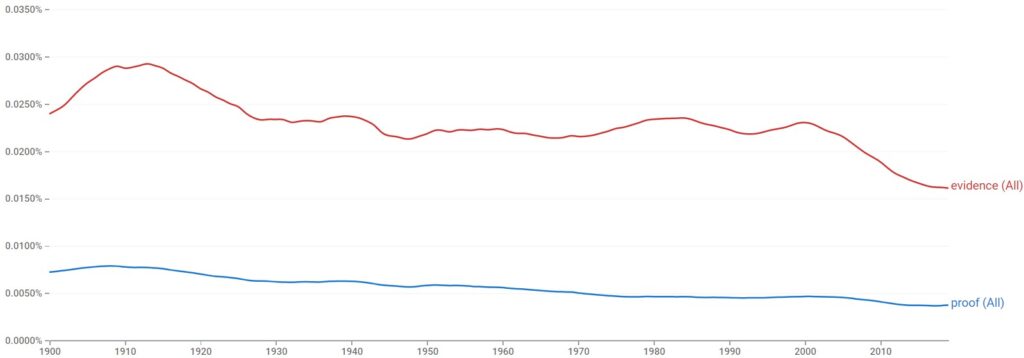
According to the Google Ngram Viewer, “evidence” has consistently been used more frequently than “proof”.
This might be the case because proof is a far more conclusive standard. Thus, people may be reluctant to state that they have proof of a particular claim.
Because “evidence” is inconclusive and allows for further speculation, it is likely safer to suggest that certain info evidences a claim rather than proving it.
Final Thoughts
“Evidence” is information that gives weight to the truth of a claim. It is often used in the context of the legal field. “Proof” is information that conclusively confirms the truth of a claim. It is mainly used in mathematics, where certain claims can be systematically and conclusively proven.

Martin holds a Master’s degree in Finance and International Business. He has six years of experience in professional communication with clients, executives, and colleagues. Furthermore, he has teaching experience from Aarhus University. Martin has been featured as an expert in communication and teaching on Forbes and Shopify. Read more about Martin here.
- 8 Words For Your Son-in-Law or Daughter-in-Law’s Parents
- How Do You Wish Someone Good Luck in Court?
- What To Call Your Wife’s Sister’s Husband (Alternatives To Brother-In-Law)
- 10 Words For Someone Who Questions Everything
What’s the difference in meaning between «evidence» and «proof»?
It looks like in this sentence there is no place for any doubts that humans existed in Saudi Arabia 20 000 years ago. If so, then the word «evidence» here, as far as I understand, can be replaced with the word «proof». Or is it like there are some nuances here that I, as a non-native speaker of English, am not seeing?
asked Oct 21, 2014 at 7:27
8,970 56 56 gold badges 119 119 silver badges 181 181 bronze badges
Your sentence actually makes it clear that there is room for doubt, because it used the word evidence. You are now saying «they write evidence, but I want to read proof. Why don’t they write proof?»
Oct 21, 2014 at 7:52
Suggested reading: en.wikipedia.org/wiki/Raven_paradox
Oct 21, 2014 at 13:30
@cobaltduck — I have read about this paradox about half a year ago, but I don’t quite understand where you see the connection between the Raven paradox and my question. Can you, please, elaborate?
Oct 21, 2014 at 13:49
Just to add to some of the excellent answers, proof only really exists in math. In the real world almost nothing can be truly proven, which is why you’ll usually see the word evidence instead, especially in a scientific context. Evidence lends support to a hypothesis (or eventually theory), but those conclusions are always open to change when new evidence is found.
Oct 21, 2014 at 14:28
This green apple is evidence that all Ravens are black. It is not proof. More of a side-bar, then a direct relation to your question.
Oct 21, 2014 at 21:12
9 Answers 9
In the simplest terms, proof is conclusive but evidence isn’t. Evidence is more of a suggestion.
In your example sentence, the use of evidence is to make it clear that there are other possibilities, such as maybe the dating being wrong, or the evidence not being human in origin.
answered Oct 21, 2014 at 7:34
Roaring Fish Roaring Fish
15.1k 1 1 gold badge 30 30 silver badges 59 59 bronze badges
I’ll confess — I used my WABAC machine to go back there and plant the evidence.
Oct 21, 2014 at 18:50
Some fine answers already, but to add a simple explanation:
Evidence may be used to form a theory or hypothesis.
Additional evidence may refine such a theory.
Proof shows the theory to be a fact.
Example: Adding one apple to a basket with another apple results in a basket with two apples in. This could be proof that 1+1 is indeed equal to 2, but only evidence that 2+2 may equal 4. We might say that adding another two apples (hopefully resulting in 4 apples in our basket) has shown proof of our theory, or that the theory has been proven.
In your example the author is saying that the evidence (e.g. maybe carbon dated pottery or the like) has led to the theory that humans existed in Saudi Arabia for at least the last 20,000 years. But just like any other theory, the conclusion built upon the understanding of this evidence may be incorrect, and even the understanding, or dating may be incorrect.
answered Oct 21, 2014 at 8:48
575 2 2 silver badges 13 13 bronze badges
«hopefully resulting in 4 apples in our basket» — 🙂 🙂 🙂
Oct 21, 2014 at 8:50
The continued answers on this question has reminded me that various disciplines do indeed play with the meaning of proof and theory, usually to facilitate discourse. In law, proof may oft mean as digitig & ornello describe; A scientific theory is often taken as fact, though are still not quite 100% immutable, e.g. the big bang theory which was created as a prediction of the standard model. But the SM is only based on our imperfect observations and also predicts dark, matter, dark energy and dark flow, of which a lot of scientists are still very sceptical of.. remember ‘aether’?
Oct 21, 2014 at 15:33
«. is only based on our imperfect observations and also predicts dark, matter, dark energy and dark flow, of which a lot of scientists are still very sceptical of.. remember ‘aether’?» — Yes. I absolutely agree with you about that.
Oct 21, 2014 at 15:45
A thing or things helpful in forming a conclusion or judgment: The broken window was evidence that a burglary had taken place. Scientists weigh the evidence for and against a hypothesis. [American Heritage Dictionary via the Free Dictionary].
The evidence or argument that compels the mind to accept an assertion as true. [American Heritage Dictionary via the Free Dictionary]
In some fields of enquiry (Law, or the Sciences) a preponderance of evidence, and a lack of evidence to the contrary, would be regarded as a proof of some statement or assertion. In others (Mathematics or Logic), no amount of evidence is a proof. Only a proof:-
a. The validation of a proposition by application of specified rules, as of induction or deduction, to assumptions, axioms, and sequentially derived conclusions.
b. A statement or argument used in such a validation.
answered Oct 21, 2014 at 8:16
Brian Hooper Brian Hooper
36.8k 54 54 gold badges 147 147 silver badges 255 255 bronze badges
«In some fields of enquiry (Law, or the Sciences) a preponderance of evidence, and a lack of evidence to the contrary, would be regarded as a proof of some statement or assertion» — So, if while I were sleeping in a car with an open window and somebody stabbed a pedestrian on the street to death and threw the knife into my car and ran away, and there were no evidence that I was not the murderer, then that would be considered as proof that I was the killer?! But that would be a terribly wrong judgment then!
Oct 21, 2014 at 8:28
@brilliant — Yes, it would be a wrong judgment. But one must distinguish between proof in a) the legal sense and b) the scientific sense. The standard for a scientific or mathematical proof to be generally accepted as valid is much higher than that often presented (or accepted) by a prosecutor, defence lawyer, judge or jury member. If you were wrongly convicted of murder, many different factors could have contributed to the assembled evidence perversely being equated with proof when it could be interpreted differently, or exonerating evidence at the crime scene might have been overlooked.
Oct 21, 2014 at 9:02
In probabilistic terms, evidence increases the probability that a proposition holds, relative to its value without such evidence, whereas proof raises the probability to certainty.
If Y is evidence for X, then
P(X|Y) > P(X) If it’s proof of X, then
P(X|Y) = 1 (Strictly speaking, a probability of 1 isn’t quite the same as certainty, but that kind of mathematical pedantry is out of scope for EL&U. )
answered Oct 21, 2014 at 9:36
chiastic-security chiastic-security
3,091 7 7 gold badges 25 25 silver badges 34 34 bronze badges
What does P stand for in your formulas? Probability or proof? I guess it’s probability. If yes, then can it be more than 1?
Oct 21, 2014 at 14:18
@brilliant It’s probability. No, it can’t be more than 1. But 1 doesn’t mean certainty: the probability that I’m not exactly 1m70cm tall is 1, but it’s not certain.
Oct 21, 2014 at 14:21
Can it be less than 1 then? Or it’s 1 if there is some probability and 0 if it’s absent?
Oct 21, 2014 at 14:29
@brilliant For all practical purposes, 0 means it’s certain not to happen, 1 means it’s certain to happen, and a value in between means it might happen. The closer to 1 it gets, the more likely it is; so 0.5 means it’s 50/50. (The distinction between 1 and certainty is a red herring: I shouldn’t have mentioned it.)
Oct 21, 2014 at 14:31
Further «P(X|Y)» should be read as «the probability of X given Y».
Oct 21, 2014 at 19:37
In order to make a case, you need evidence and an argument. Evidence without argument is just a pile of uninterpreted facts. Argument without evidence is just assertion.
When you have a case, the next question is how convincing that case is. Is the argument a good one? Is the evidence open to other interpretations? Whether the case is proof or not depends on the standard of proof you are looking for. In UK civil court cases, a case is considered proof if it is true «on balance of probabilities», that is, if the court is persuaded that the claim is more likely true than not true. In criminal cases, a case is not considered proof unless it is «beyond reasonable doubt» — the evidence and arguments are so good that no reasonable person would doubt it. And in mathematics, even that level of proof isn’t good enough: something has to be shown to be true beyond possibility of contradiction (ok, I’m blurring the distinction between «evidence» and «axioms» on that last one).
What all this comes down to is that «proof» is a sliding scale, but that wherever you are on it, evidence alone is only one part of a proof.
answered Oct 21, 2014 at 12:19
570 2 2 silver badges 4 4 bronze badges
In basic terms, evidence + best argument = proof. ‘Evidence’ can be either physical or testimonial.
In criminal law, the basic evidence is only part of the case. If the prosecution can make a better argument based on the evidence available (bullets, blood, DNA, footprints, fingerprints) than the defense can to explain these things away, you have ‘proof’, i.e., ‘beyond a reasonable doubt’. So, if the prosecution can make a better case than the defense, they have proved their case. ‘Proof’ has to come up to a standard, which varies according to the kind of case it is (‘beyond a reasonable doubt’ for some cases, or ‘preponderance of the evidence’ for others).
answered Oct 21, 2014 at 13:51
910 6 6 silver badges 9 9 bronze badges
Evidence is some fact that supports a theory. There may also be other, incompatible theories that would also be supported by the same evidence, so either of them may still be right or wrong.
Once there is proof, that means that there is enough of the right evidence that it all supports the theory, and it’s not possible that it’s not true.
Maybe you believe that Earth has the shape of a cylinder. You travel all the way around it in a ship, and end up at the same spot! Evidence for the theory that Earth is a cylinder, because if it’s a cylinder, then that would be possible.
But it’s also evidence for the theory that it is a sphere. But then people find the poles, they travel around it in several different directions, and eventually we go into space — lots of evidence against the cylinder, in fact enough to prove that it’s not a cylinder at all (this is just an example, I’m quite sure it was easy to prove Earth is not a cylinder much earlier :-)).
Eventually we gather so much data with satellites et cetera that we know exactly what the shape of the earth is, and it’s almost a sphere, but slightly flattened. We know so much about it that that can be considered proven.