The two speed economy — what does the NEO consumer look like and how can we connect with them?

The current economic environment is making many consumers rethink and pull back on their spending. Yet, this isn’t necessarily true for New Economic Order (NEO) consumers. Bucking the trends of frugality and motivated by a desire for premium brands and experiences, NEOs are driving discretionary spending and creating a fast lane in the two speed economy.
At A.H. Beard, NEOs are at the heart of our business and for the last 123 years we’ve been committed to mastering the art of Premium Sleep. During this period, the global and local economy has changed — and our compass for navigating shifting business and consumer cycles has been understanding NEOs and delivering on their wants, desires, and expectations.
What is a NEO?
To understand how we’ve tapped into the NEO consumer, we need to first understand what makes a NEO. According to our Roy Morgan research, we operate in a two-speed economy defined by ‘NEOs’ and ‘Traditionals’ with very different mindsets.
NEOs are socially progressive, high-spending consumers that spend more than 300% more than their traditional counterparts. Traditionals, on the other hand, are guided by logic and a propensity for saving and considered spending. But don’t be fooled — NEOs aren’t a small subset of our market. In fact, they make up nearly a quarter of the population.
NEOs, like the average consumer, spend on ‘essential’ items however are set apart by their high levels of discretionary spending on the latest technology, travel experiences, discovering new places to dine, premium drinks, progressive financial options and services that ultimately elevate their lives.
And for this group, wellness is a key part of their lives — especially in a post-COVID era. This is contributing to a rise in luxury health tourism, increased spending on health foods and supplements and gym memberships, as well as health technology and aids.
This is where sleep fits into the equation, as a key pillar of health. And the demand for Premium Sleep amongst NEOs is clear, with the global market for sleeping aids projected to reach $168.98 billion within the next decade.
NEOs and Premium Sleep
When we think of sleep aids, many of us will think of wearables, which don’t just track our activity but our sleep too. But the foundation to unlocking Premium Sleep quite literally is the bed we’re lying on — a fact which is increasingly recognised and welcomed by NEOs.
An example of this is our growth and success in China. A decade ago, we observed strong NEO behaviours in China’s economy, including a focus on wellness and preference for premium brands. It’s for this reason that we focused on expanding A.H. Beard’s brand presence in the China market and delivering Premium Sleep to its growing population. As one of the globe’s largest bedding markets with 1.4 billion consumers, China’s sleep landscape is currently showing the most engagement.
While NEOs exist across the world, their consumer mindsets and behaviour will be influenced by the local landscape. Our leading partner, Shanghai Green, helps us understand the local market conditions and trends affecting NEOs in China so that we can better relate to them.
For example, the consumer market is traditionally price-led — with sales and discounts often shouted at the consumer. While these tactics are likely to work on a traditional consumer, they’ll have the opposite effect on a NEO. So being aware that NEOs want to self-discover, we’re very conscious about how we engage with our audience and opt for a more experiential process.
Speaking of the China market specifically, as an indication of success — A.H. Beard now has 50 stores across China, plans to open 50 more and a best-selling product retailing at $75,000. There’s no doubt that this is a reflection of the level of exceptional quality, performance and personal service that NEOs desire and expect.
There’s no doubt we’re operating in a two-speed economy. And the fast lane is being driven by a premium brand of recession-busting consumers known as NEOs. As our highest spending consumers in the economy, it’s their mindset that’s shaping the future. And if history is any guide, businesses who follow them will discover a more successful future.
Tony Pearson is CEO of A.H. Beard.
Neo consumer что за понятие
Consumers are classified into NEO consumers, aspiring NEO consumers and traditional consumers. NEO stands for “New Economic Order”.
Some of the characteristics of NEO consumers are:
• High discretionary choice
• Powerful social and business influence
• Most likely be in a professional or management occupation
• Extroverted and active on the internet
The following are the reasons for the increase in the number of NEO consumers in India:
• Increase in the number of affluent middle-class families
According to a survey conducted in 2015, the average of NEO populations comprised of 49% with an average of 39% of spending. This number since then is continually increasing. It is predicted that the number of people belonging to the affluent category will touch 40%.
• Increase in Urban population
Unlike other countries, India has shown diversified growth. It is the second most populous country and due to improvement in income, education and the quality of living, most of the rural class is migrating to Urban. By creation or new cities, it is estimated that by 2025, more than 40 percent of the population will live in the urban cities.
• Increase in nuclear family
The concept of joint families is slowly becoming thing of the past. People prefer to live in nuclear families due to varied reasons. It is observed that consumption and spending in a nuclear family are 20% higher as compared to joint families.
• Change in the mindset to live life king size
Who does not want to live a sophisticated life? After the fulfillment of basic amenities such as food, clothing, and shelter, people have shifted to a richer lifestyle. They spend their excess money on education, leisure activities, and digital media. Also, due to the increase in income, the price of the commodity which is brought has also increased.
• Digital India: Access to the internet
Our forefathers and even our fathers have very minimal knowledge of the digital world. We, the next generation, seem to be clueless without the internet. From doing our assignments, projects to searching jobs etc is just one click away. Our Prime Minister’s prime ideology is to make India digital. As a result, buying and selling, booking tickets and making payments are done online. As a result, it serves as a medium to enhance one’s livelihood.
• Access to products and services
In olden days, education was not complete without proper schooling and due to limit schools, people used to travel many miles to reach their school. But now knowledge is made available in our homes. People opt for online classes where a person in India is able to take classes from a British professor. Also, shopping sites such as Amazon and Flipkart have made goods from around the globe much more accessible.
The basic reasons are due to an increase in the income, purchasing power and access to products.
Consumer obligation/duties
Consumers should be familiar with the product. They should be aware of the uses and proper consumption of the product or services.
They should read the instruction manual and should be aware of the warnings. Seldom NEO consumers pay attention to the manual.
The consumer has the obligation to maintain the payment receipt and warranty card of the product for the after-sales services. NEO consumers often buy online and the receipts are stored online in the account.
Consumer protection
Central Consumer Protection Authority (CCPA) is set up in 2018, which will deal with unfair trade practices and misleading advertisements.
There has been a lot of misleading information or deceiving advertisements which have the potential to influence young people into buying, Deodorants, Fairness creams are good examples.
Also, there are chances of selling defected products or duplicate products which are dangerous to use. Cellphones with improper battery have caused harm to the consumer in the past.
Who is the Neo-Consumer & Why Should I care?

If you were fortunate enough to attend MAGIC: Part One, you might agree that beyond the celebrity sightings and sneak peaks of next season’s threads, the take-away was in Jamie Gutfreund’s seminar, The Connected Consumer.
Gutfreund heads up Business Development for The Intelligence Group, a youth-based, consumer insights company, and works with brands, such as Microsoft, Walt Disney, Visa, Honda, Adidas, and Nordstrom.
She opened her talk with a throwback media medley of all things pop culture, as defined by Gen Y. Struggling for a visual? Think boy bands, Britney Spears and anything you may have seen on I Love the 90’s.
After drawing a few laughs from former TRL watchers and Real World enthusiasts, she laid the groundwork for a conversation about culture:
“It’s Culture over Category: You want to be the Starbucks, not the Folgers.”
So, how does a brand become the Starbucks? They tap into the minds of Gen Y – the 75 million people born between 1980 and 1995. The reason? Gen Y’s are more peer-conscious than preceding generations.
Say hello to what Gutfreund calls The “Peer-ents” affect.
This cohort of individuals does not just consider what their friends think; they base decisions on what their friends think. With a single tweet or status update, Gen Y’s crowd-source for feedback. With a like, tag, comment or share they provide feedback.
Gen Ys are defined by their social profiles. The notion that “I am what I share” is widespread. They’ve been encouraged to share and they’ve been applauded for their creativity all along. But, what they create and what they share lives on display.
As a result, we have the Pseudo Individual – the individual with the Group Ethos:
“I want to be different, like all of my friends.”
For brands to be liked by Gen Y, brands must give them something that makes them look good for sharing it.
What’s more? These 15-30 year olds are empowered by technology. They need technology to interact and they expect 24/7 interaction. Gutfreund raised the question “If a party happens and no one tweets about it, does it really happen?”
Since the Gen Y consumer is able to build an app or create a trend, they expect their brands to be just as creative – if not, more.
So, as Gutfreund said, “Understanding behavior drives new thinking”. Be creative. Be connected constantly and across channels. Lastly, Invite their creativity.
The two speed economy — what does the NEO consumer look like and how can we connect with them?
The current economic environment is making many consumers rethink and pull back on their spending. Yet, this isn’t necessarily true for New Economic Order (NEO) consumers. Bucking the trends of frugality and motivated by a desire for premium brands and experiences, NEOs are driving discretionary spending and creating a fast lane in the two speed economy.
At A.H. Beard, NEOs are at the heart of our business and for the last 123 years we’ve been committed to mastering the art of Premium Sleep. During this period, the global and local economy has changed — and our compass for navigating shifting business and consumer cycles has been understanding NEOs and delivering on their wants, desires, and expectations.
What is a NEO?
To understand how we’ve tapped into the NEO consumer, we need to first understand what makes a NEO. According to our Roy Morgan research, we operate in a two-speed economy defined by ‘NEOs’ and ‘Traditionals’ with very different mindsets.
NEOs are socially progressive, high-spending consumers that spend more than 300% more than their traditional counterparts. Traditionals, on the other hand, are guided by logic and a propensity for saving and considered spending. But don’t be fooled — NEOs aren’t a small subset of our market. In fact, they make up nearly a quarter of the population.
NEOs, like the average consumer, spend on ‘essential’ items however are set apart by their high levels of discretionary spending on the latest technology, travel experiences, discovering new places to dine, premium drinks, progressive financial options and services that ultimately elevate their lives.
And for this group, wellness is a key part of their lives — especially in a post-COVID era. This is contributing to a rise in luxury health tourism, increased spending on health foods and supplements and gym memberships, as well as health technology and aids.
This is where sleep fits into the equation, as a key pillar of health. And the demand for Premium Sleep amongst NEOs is clear, with the global market for sleeping aids projected to reach $168.98 billion within the next decade.
NEOs and Premium Sleep
When we think of sleep aids, many of us will think of wearables, which don’t just track our activity but our sleep too. But the foundation to unlocking Premium Sleep quite literally is the bed we’re lying on — a fact which is increasingly recognised and welcomed by NEOs.
An example of this is our growth and success in China. A decade ago, we observed strong NEO behaviours in China’s economy, including a focus on wellness and preference for premium brands. It’s for this reason that we focused on expanding A.H. Beard’s brand presence in the China market and delivering Premium Sleep to its growing population. As one of the globe’s largest bedding markets with 1.4 billion consumers, China’s sleep landscape is currently showing the most engagement.
While NEOs exist across the world, their consumer mindsets and behaviour will be influenced by the local landscape. Our leading partner, Shanghai Green, helps us understand the local market conditions and trends affecting NEOs in China so that we can better relate to them.
For example, the consumer market is traditionally price-led — with sales and discounts often shouted at the consumer. While these tactics are likely to work on a traditional consumer, they’ll have the opposite effect on a NEO. So being aware that NEOs want to self-discover, we’re very conscious about how we engage with our audience and opt for a more experiential process.
Speaking of the China market specifically, as an indication of success — A.H. Beard now has 50 stores across China, plans to open 50 more and a best-selling product retailing at $75,000. There’s no doubt that this is a reflection of the level of exceptional quality, performance and personal service that NEOs desire and expect.
There’s no doubt we’re operating in a two-speed economy. And the fast lane is being driven by a premium brand of recession-busting consumers known as NEOs. As our highest spending consumers in the economy, it’s their mindset that’s shaping the future. And if history is any guide, businesses who follow them will discover a more successful future.
What is a Neo-consumer?
Described as «super consumers», Neo-consumers are a powerful group of spenders who make up one quarter of the population, but represent half of all discretionary spending.
After more than five years of research, Ross Honeywill and Verity Byth of the Centre for Customer Strategy, pinpoint two distinctive social types in Australia: Neo-consumers and Traditionals. Neo-consumers aspire to own things that are better than they have now. They are spenders, not savers, and are comfortable with buying luxury goods. They like to purchase on impulse and, for them, style is more important than price. Cynical of big business, media and governments, Neo-consumers believe in the power of the individual and insist on making connections that are relevant and intensely personal. The Neo-consumer prefers to eat out, will fly more often and buy twice as many books as their Traditional counterpart. Traditionals prefer large-scale shopping malls and are always on the lookout for a good bargain. Traditionals and Neo-consumers perceive brands in completely different ways. To a Traditional, a brand is a short-cut to certainty and confidence. A Neo-consumer by contrast delves behind the brand to understand its origins and authenticity — no Tom Foolery going on here. Neo-consumers are changing the face of business and understanding the forces that drive a Neo-consumers can give a valuable window into the needs and wants of the high-margin, discretionary goods consumer.
Have something to say on this? Share your views in the comments section below. Or if you have a news story or tip-off, drop us a line at adnews@yaffa.com.au
Sign up to the AdNews newsletter, like us on Facebook or follow us on Twitter for breaking stories and campaigns throughout the day.

AdNews Newsletter
The AdNews enewsletter, brings you the latest advertising and media news direct to your inbox! Become a member and get the weekly newsletter free!
Похожие публикации:
- Как работают play to earn игры
- Какой курс доллара на алиэкспресс
- Ошибка 10 01 в сбербанк онлайн что делать
- Что случилось с рублем сегодня
Neo Platform (NEO): What Is It And How Does It Work?

NEO started its life as AntShares in 2014. It was founded in China by Da Hongfei and Erik Zhan. It was rechristened as NEO in June 2017. In this post, we will find out more about it. Let’s get started.
Neo Platform (NEO): All You Need To Know
What is NEO?
NEO aims to automate the management of digital assets using smart contracts with the aim of ultimately creating a distributed network-based smart economic system. NEO is an open-source, community-driven blockchain platform. As the most featured blockchain platform for building decentralized applications, NEO enables developers to digitize and automate their asset management through smart contracts. It also provides strong local infrastructures such as strong decentralized storage, specializations and domain name service, while creating a secure foundation for the next generation internet.
Who founded NEO?
NEO is known as the first premium smart contract platform. NEO was founded under the name Antshares in 2014 by Da Hongfei and Erik Zhang. The original source code was published on GitHub in July 2015 and subsequently launched on the MainNet in October 2016. It is also supported by the global developer community, which continues to advance the blockchain.
In 2017 Antshares rebranded NEO by integrating smart contracts 2.0. However, there has been an aggressive global development as hundreds of new developers come to the blockchain. NEO administrators have started to distribute NEO tokens as gifts to groups and individuals who support the growth of the platform. Groups such as COZ, NEOEconoLabs, and O3 Labs are known as early entrants to NEO.
In 2021, it was upgraded to version 3.0, known as NEO N3. A project launched in June 2018, N3 represents the largest development in NEO history. It aims to bring the industry’s first all-encompassing blockchain development experience and includes powerful native features such as distributed storage, specializations, and name service.
NEO N3 also supports simpler and more modular systems as well as improved management and economic model compared to previous versions. NEO is considered to be the early pioneer of the blockchain industry. It is not only the first public smart contract platform established in China, but also the first on-chain to use the token model and the first to implement the BFT (Byzantine Fault Tolerance) style consensus mechanism. Besides,
What is NEO’s practice philosophy?
In the evolving and expanding time, NEO’s Shanghai-based operation has grown from under a dozen numbers to over fifty, its organizational structure has matured. The number of groups dedicated to improving NEO’s technology has increased. Today, there are developers from all over the world who contribute to the core development, infrastructure and tooling of NEO, including graduates from companies such as Microsoft, Facebook, Amazon, Samsung, Dell, Seagate.
The main groups working on NEO can be listed as follows:
- NEO Foundation
- Core Developers
- NEO Global Development
- Sponsored Community Groups.
In the eyes of idealists, NEO’s most overarching goal is to be a decentralized and open network for the smart economy. However, pragmatists are aware that some central coordination must occur in order to achieve this goal over time. To this end, the NEO Foundation was established for the NEO platform as a strategic guide. This institution sets the overall goals for the project as an organization and provides funds for other self-directed groups to achieve goals that will contribute to the organization.
NEO also acts with the awareness that the blockchain industry cannot overcome its existing legal systems or create these systems with solutions that are completely incompatible with current business frameworks. Instead, he advocates working together in building the future of the smart economy.
NEO has taken an approach to this problem such as designing standards-making by forming or joining various industrial groups, increasing access to infrastructure and training legislators. With the launch of NEO N3 in 2021, NEO decentralization will also take its biggest step forward. NEO holders will have the right to vote in the administration of the blockchain, the NEO council is responsible for running consensus nodes and setting critical blockchain parameters such as transaction fees.
What sets NEO Cryptocurrency apart from other cryptocurrencies?
Considering the restrictions on the transfer of cryptocurrencies by the Chinese Government, NEO has the potential to emerge as the cryptocurrency of choice in countries with strict regulations and perhaps all over the world. NEO’s Onchain technology has been designed from its inception to be regulator friendly with a centralized approach that is quite different compared to the majority of cryptocurrencies. This could help it survive and prosper, even in China, where government regulators are looking at the world of cryptocurrencies with an increasingly objectionable eye. The government is concerned about the financial risks posed by cryptocurrency speculation. At the same time, large cryptocurrency mining operations consume the country’s electricity supply in large quantities, which is starting to threaten the country’s environmental goals.
What are the digital equivalents on the NEO platform?
Theoretically, the NEO smart economy system is explained as digital assets + digital identity + smart contract = smart economy. Assets can easily be digitized in a way that is open, decentralized, reliable, traceable, transparent and independent of intermediaries and costs. Users can register, sell, exchange or circulate various assets.
The NEO platform allows private digital and physical assets with an equivalent token to be linked in its network. NEO also supports the protection of assets. These assets are registered on its platform, given a valid digital identity and protected by law. Smart contracts allow the execution of transactions and agreements between different parties without being managed by any legal system or central mechanism. The implementation of such contracts is based on the programming code of the network, and the coding ensures traceability, transparency and irreversibility of transactions.
NEO supports two cryptocurrencies, GAS and NEO. It supports programming in all common languages, including C#, Java, Go, Python, and Kotlin, making it easy for a large community of developers to contribute to its platform.
Is NEO Legal?
NEO clearly differs from other standard blockchain platforms in terms of compliance. Although digitized assets and smart contracts are popular on other blockchain platforms such as Ethereum, the third key feature called “digital identity” sets NEO apart from the others.
Every individual, business or other legal entity operating on the NEO platform must have a unique digital identity that can be verified. Individuals, businesses and projects have the option to transact among themselves only if the other party has the required identity. This makes the NEO network compatible with legal regulations. Even the various nodes in the NEO network are required to have identities in order to contribute to transaction verification and other activities such as accounting and bookkeeping.
What is Onchain?
In their work on NEO, cryptocurrency founders Da Hongfei and Erik Zhan have gained the attention of various businesses looking for custom blockchain solutions. This search for solutions led to the founding of Onchain in 2014, an independent technology company that operates within the required financial and legal frameworks and provides blockchain solutions to a variety of businesses.
While NEO works like Bitcoin (which can be traded on bitcoin profit) and Ethereum, Onchain focuses on the creation of private and international trade association blockchains to meet the specific needs of the industry. Onchain’s core product, the Distributed Networks Architecture, uses digital asset applications to assist businesses by creating private and public blockchains. It is believed that DNA is a blockchain that can be customized to solve all kinds of different problems in the private and public sectors.
What is the difference between NEO and Onchain?
NEO and Onchain exist separately, in other words, one does not own the other. While NEO targets the Business to Consumer segment, where the “C (Consumer)” can refer to a customer or even a community, Onchain focuses on enterprise services based on Business to Business. NEO is funded by a public community, while Onchain is backed by China’s largest private conglomerate called Fosun.
When asked why Fosun was chosen as an investment partner, founder Da Hongfei said, “Their portfolio includes the three main branches of finance, medical science, entertainment and lifestyle with good synergies with blockchain technology. That’s why, choosing Fosun Group as their investment partner, they highly value the Enterprise resource Fosun provides, a platform for Onchain to showcase blockchain technology.
What are the visions of NEO and Onchain?
The co-founders of NEO and Onchain envision that they will be able to achieve cross-chain collaboration in the future. In other words, a mechanism will be developed to connect and share information between blockchains, whether public like NEO or private like those run by businesses. As the number of blockchain-based systems continues to grow in both the public and private sectors, there will ultimately be a need for cross-industry collaboration.
Working groups at NEO and Onchain hope to fill this gap with their ongoing work. However, trust and identity become important to ensure this type of interoperability. This gap will be filled by the core digital identity feature that is an integral part of the NEO blockchain platform. It appears that NEO and Onchain could pave the way for a much-needed middle ground between fully decentralized, unregulated and anonymous blockchain systems like Bitcoin and the traditional KYC (Know Your Customer) compliance of today’s bank accounts and credit cards.
NEO and Onchain take a multi-service approach that tries to accommodate and serve the needs of all parties in their existing structures, such as individual users, network contributors such as miners, transaction participants, private businesses and even regulators, closed economy regulators and open system cryptocurrency investors. These are the areas that are best created to provide holistic solutions to the ongoing conflicts between them.
NeoBanking-The rise of new-age banking
Bridging the shortcomings of traditional banking through integrated value chains and regulatory requirements, neo banks today offers a holistic twist to banking services. User-friendly and completely digital, these banks work on referral-based acquisition and competitive pricing.
With no banking license of their own, neo banks partners with traditional banks to offer their service suite. While this might be a pain point, neo banks target niche micro-segments like the Gen-Z because of their higher transaction volumes. Coupled with Data Analytics, neo banks bring forth innovative solutions to help individuals keep better track of their finances.
For instance, our client Finin, India’s first neo bank, has brought on a feature where users can have a unified view of their bank accounts via their platform. It helps a user to keep better track and plan their financial journey.
Unbundled Banking
Neo banks today are focusing on offering one type of product/service with complete functionalities. They operate with customized tech stack modules aimed at niche segments with user convenience as the focal point. Some of the top global neo banks are Revolut, Monzo, WeBank, Chime, etc.
Paradoxically, legacy banking institutions cannot create these experiences as they face redundant processes, interoperability, etc. Fintech professionals realized that an obsolete technology stack was limiting the interoperability of traditional banking. This, in turn, guided the notion of Unbundled Banking, with neo banks steering the helm.
Unbundled banking further narrowed that focus on customer experience, user convenience, and simplified processes. In this approach, anyone can launch banking products minus the need to go through a rigorous process of setting up a bank.
Neo Banking Revenue Model
Neo banks operate on a strong cost-efficient model backed by less complex IT systems. So, their revenue model depends on the kind of products and services offered by them. Cross-selling of products/services to niche customer segments also acts as a secondary revenue stream for neo banks.
They are driven by data-based decisions that depend on a decision-making model. Neo banks gather consumer data and analyze them and predict consumer behavior. These predictions help to offer customized services to their target customers. By deploying AI-driven chatbots, video chats, and data analytics, neo banks are available to customers as a cost-effective banking service right at their fingertips.
Neo banks cross-sell and generate secondary revenue streams with a range of customized offerings suitable to customer’s needs. They also offer payments and accounts back-end platforms for other fintech companies to build their own interface on top of it.

Plug and Play solutions with 3rd party service providers with ease and data insights. With this, they can offer a range of products and services based on customer appetite and financial goals to boost up the secondary revenue lines and opportunities for cross-selling. Boosting lending options to customers and the SME sector will help generate revenue options.
Neo Banks & the less-digitally savvy users
The audience that comprises this segment is often elderly and rural customers; capturing their trust is quite an uphill task for neo banks. They gain such customers with a free account and low fees and budgeting tools and cash projections based on past spending, and ‘savings pots’ for spend categorization. Offerings like High-Yield Savings Accounts and easy money movement through lower fees & charges are some ways.
Neo bank growth can be accelerated through adaptable services and convenience in money transfer like cheaper lending rates and better rural audiences’ products. Creditors can choose borrowers and information from diverse sources and technology-based lending. Like how social media platforms have pulled in rural customers, neo banks also need to create awareness through their user-friendly applications.
Reduced data rates & smartphone prices will also encourage rural customers to use neo banking apps and gain trust.
Neo Banks & Transparency
The issue of banking transparency is closely linked to financial inclusion. Neo banking transparency can be improved through dashboards, reports across products with enhanced interfaces, and easy-to-understand services such as payments, payables and receivables, and bank statements. They must explain real-time notifications, any charges, and penalties incurred by the customer too. They should send instant alerts to customers to know exactly what is going on with their account.
Security & Privacy
Neo banks were the primary users of security-enhancing models. These were MCC block, single-use virtual cards, and tokenized online transactions. They rely on security and safety when designing platforms, like data localization or 2-factor authentications (2FA) for card-based transactions.
Neo banking enables third-party financial service providers (TPPs) to access customer data from banks or financial institutions. They must maintain robust online anti-fraud systems and inform customers of breaches as soon as it happens.
Customer permission is required to ensure data privacy or share certain information with banks or providers. For instance, if the customer gave consent, they can share financial data like spending habits and regular payments with other banks.
Providers must comply with GDPR regulation and data protection rules. They must provide transparency on how and for what the data will be used, for how long before they get a customer to sign up.
Trust
Neo banks have strong drivers for securing their customers’ accounts, which are reputation management & consumer perception. Developing trust can also be a challenging factor for loyal traditional banking customers. Fines, data breaches, and attacks can significantly damage consumer trust in non-traditional banks. Therefore, neo banks must protect consumers from mobile Trojans phishing scams and account takeover attempts. They can earn consumer trust through advanced authentication concepts such as dynamic linking, device binding for mobile apps, mobile application shielding, and transaction risk analyses.
Strong privacy and data protection policies like removal of hidden fees and charges can help build consumer confidence in neo banks.
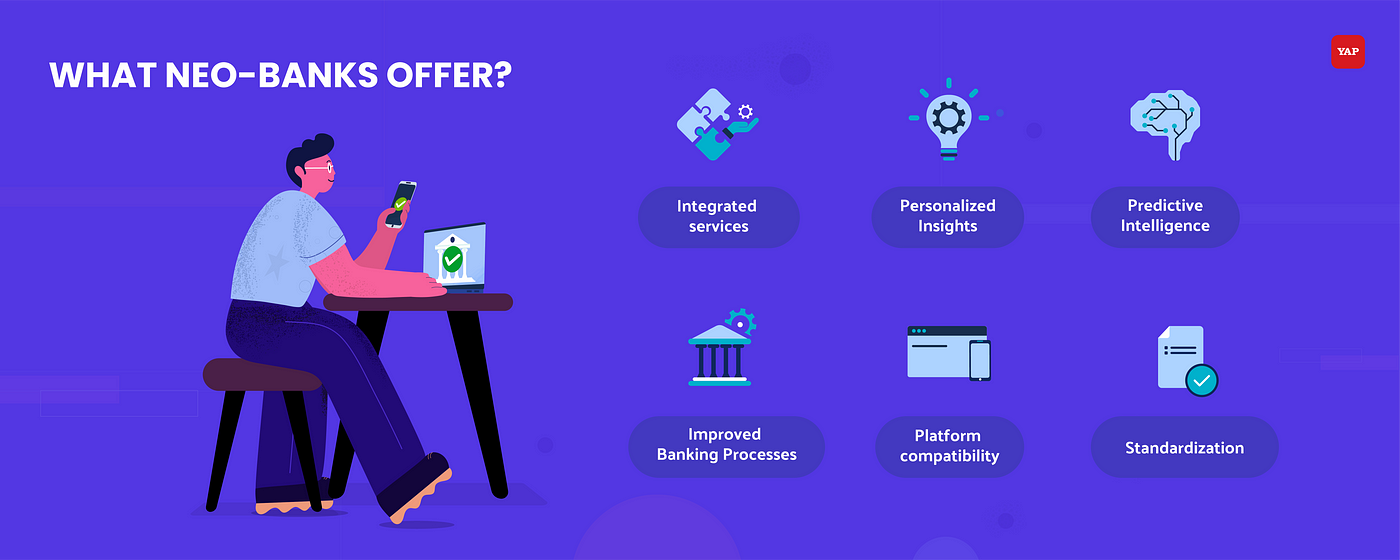
Neo banks are trying to simplify the ways of transacting through digital mediums through:
1. Simplified process with minimum steps to complete with minimum redirect for the transaction/payment
2. Tightly tying up and different players in the ecosystem (Retailers, Digital Service Providers, Issuer and Acquirer banks, etc.)
3. Standardization across devices and internet browsers
4. Compatibility across platform and technologies
5. Educating conventional customers on digital payment and ensuring that money is safe.
Neo Banks Vs. Traditional Banks
Traditional banks are focused on product-centric models, meaning high verticalization of products, no strong communities built around the brand/product, increased customer acquisition cost, and legacy technology infrastructure.
But currently, traditional banks have been increasingly offering unique products and services to customers. One might wonder how neo banks will continue to differentiate themselves from conventional banking as a result.
Neo banks can tackle product competition by keeping the focus on a platform-centric model. For example, high community engagement with the product, product horizontalization with best-in-class apps, open-banking APIs, and capitalize on a mobile-only approach for the low customer acquisition cost. A lower dependency on 3rd party providers and real-time data integration and management might help too. Above all, customer-centric organizational design and customer needs to drive data architecture.
Neo banks create an ecosystem of services around their infrastructure, shifting the banking value from branches to their API layer. They expand their user base by providing services on a 3rd party platform or offering 3rd party services on their platform.
The neo banks’ value propositions & CLV is based on lower costs, personalized insights, predictive intelligence, user-friendly interfaces, easy accessibility, and simplified processes.
The Global Way Forward
On a global scale, neo banks are on an upward growth trajectory in Europe, followed by America. The real neo bank growth is being unlocked in the APAC region, with many countries devising their virtual banking systems.
Hong Kong, Taiwan, and Singapore have already implemented virtual banking licensing, with Thailand and Malaysia following suit.
In India, neo banks are still nascent. Still, they are playing a leading role in helping small businesses to manage finances conveniently and comprehensively. The data below shows that the Indian neo banking market is growing fast:
- Average market maturity of India is 2–3+ years compared to 5–6 years+ in Europe and the US.
- Number of neo banking players in India has gone up in the recent past compared to global markets.
- Fund raised by Indian neo banks have gone up to $168 million
- Indian neo banks are boosting up the competition through value-added services apart from standard offerings.
- Indian Government supports the MSME sector through different schemes that open up Indian SME neo banks opportunities.
Neo banks are expected to explore strategic partnerships with established traditional banks to grow in India. The Reserve Bank of India (RBI) has not permitted a digital license to neo banks yet. RBI has initiated the change by providing a license to small finance and payment banks, to begin with. Banking Industry experts are hopeful that RBI will also work on policies to approve banking license for digital-only or neo banks soon in the post-covid-19 era. This will keep the fate of neo banks blurry.
Conclusion
Fintech will continue to push neo banking as the new normal. The pandemic is just a catalyst to ignite the digital transformation. Neo banks are challenging mainstream traditional banks. They are backed up by digital backing licenses and control most of the value chain from front-end to back-end.
Till then, neo banks in India will have no option but to continue partnering with the traditional banks to offer services.
Subscribe to our newsletter and get the latest fintech news, views, and insights, directly to your inbox.
Follow us on LinkedIn and Twitter for insightful fintech tales curated for curious minds like you.
0 Comments
Trackbacks/Pingbacks
- Neo Banking 101: All you need to know|M2P Fintech Blog — […] and qualities. The below image brings out the characteristics between three popular banks — Neo Banks, Digital Banks, and…